Research article2025-02-26
Accelerating Dual-directional Sulfur Conversion through Optimal p-Band Centers and Interfacial Charge Redistribution for High-Efficiency Li-S Batteries
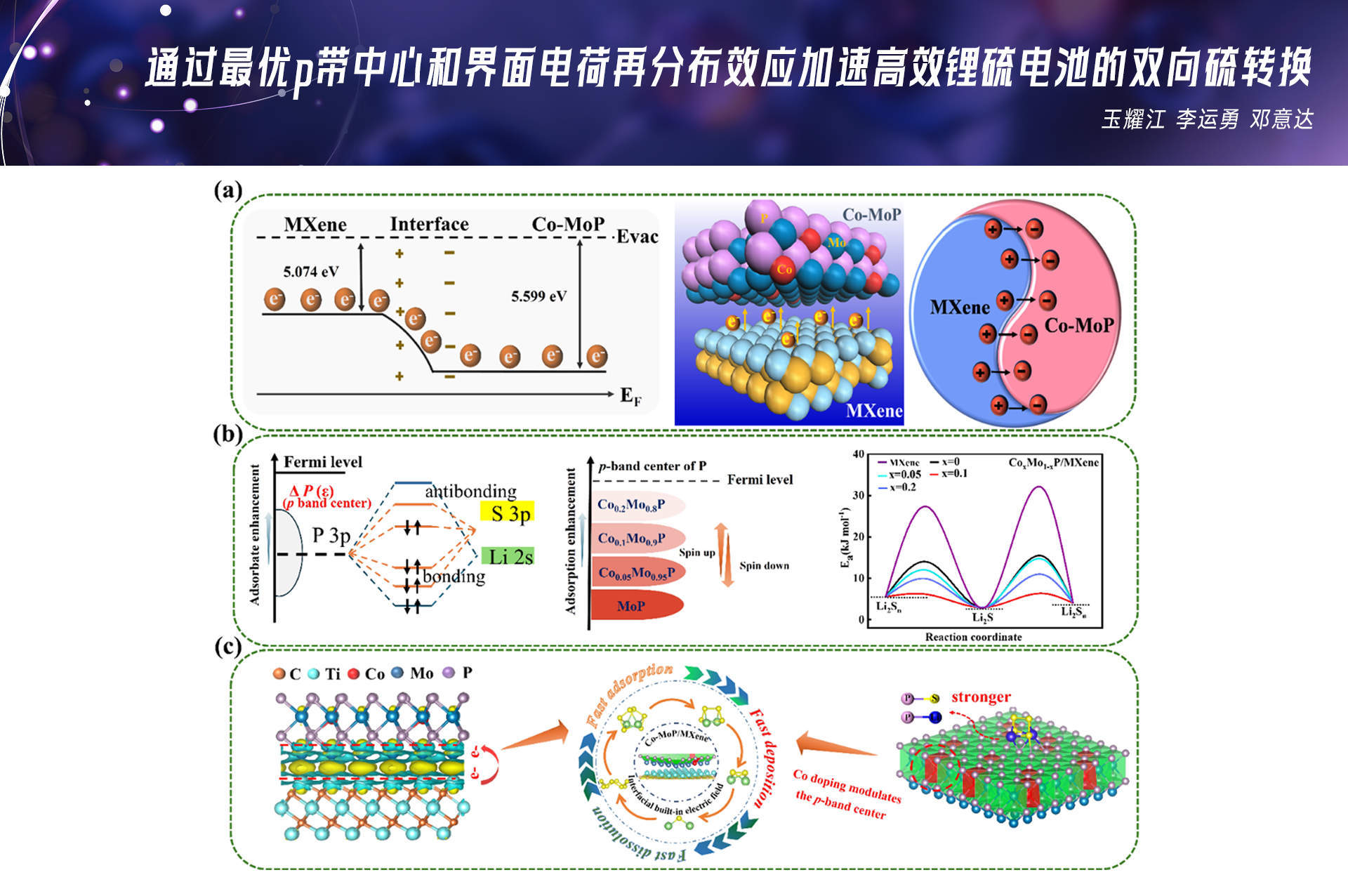
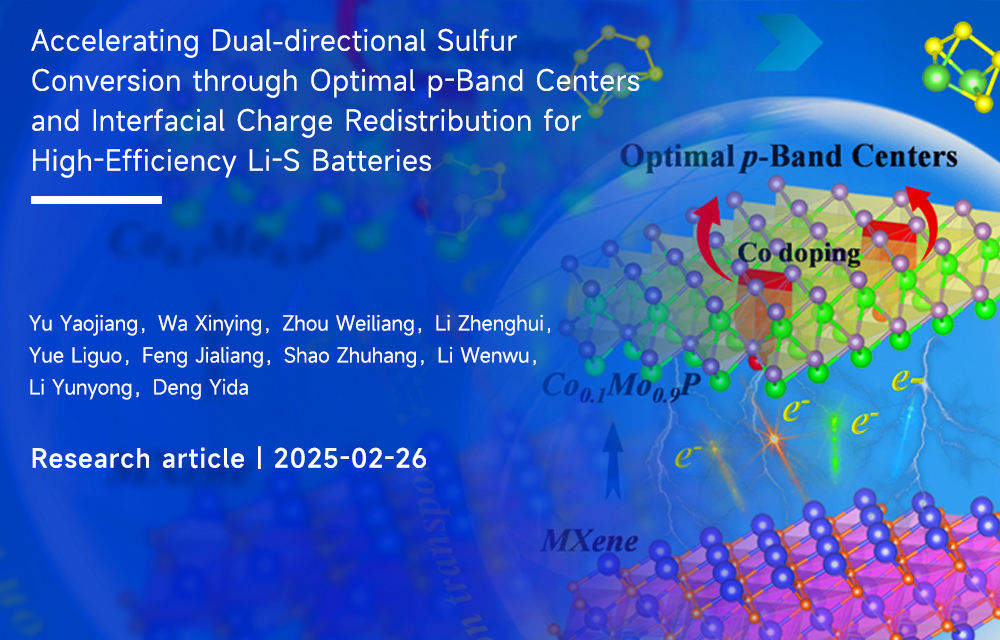
AbstractDespite extensive investigation into various electrocatalysts to enhance the progressive redox transformations of sulfur species in Li-S batteries (LSBs), their catalytic abilities are often hindered by suboptimal adsorption-desorption dynamics and slow charge transfer. Herein, a representative Co0.1Mo0.9P/MXene heterostructure electrocatalyst with optimal p-band centers and interfacial charge redistribution is engineered as a model to expedite bidirectional redox kinetics of sulfur via appropriate Co doping and built-in electric field (BIEF) effect. Theoretical and experimental results corroborate that the optimal Co-doping level and BIEF heterostructure adjusts the p-band center of active phosphorus sites in Co0.1Mo0.9P/MXene to optimize the adsorption properties and catalytic performance of sulfur species, the BIEF between Co0.1Mo0.9P and MXene significantly decreases the activation energy as well as Gibbs free energy of rate-determining step, accelerates interfacial electron/Li+ transfer rate during cycling, thereby accelerating dual-directional sulfur catalytic conversion rate in LSBs. Consequently, the S/Co0.1Mo0.9P/MXene cathode attains a large initial capacity of 1357 mAh g-1 at 0.2 C and a 500-cycle long stability (0.071% decay rate per cycle) at 0.5 C. Impressively, the high-loading S/Co0.1Mo0.9P/MXene cathode (sulfur loading: 5.2 mg cm-2) also presents a remarkable initial areal capacity (6.5 mAh cm-2) with superior cycling stability under lean electrolyte (4.8 μL mgsulfur-1) conditions, and its Li-S pouch cell delivers a high capacity of 1029.4 mAh g-1. This study enhances the comprehension of catalyst effect in Li-S chemistry and provides important guidelines for designing effective dual-directional Li-S catalysts.Graphical abstractRational regulation of p-band centers and interfacial charge redistribution in phosphide-based heterostructures is proposed via the combination of optimal Co-doping levels and built-in electric field, the as-designed S/Co0.1Mo0.9P/MXene cathode demonstrates moderate adsorption for polysulfides, rapid electron/Li+ transfer rate, and excellent bidirectional sulfur conversion kinetics. Consequently, it achieves a large initial capacity, a stable long-term lifespan with 500 cycles and a high areal capacity under high sulfur loading and low electrolyte conditions.